
A More Targeted Approach to Disc and Nerve-Related Pain
Spinal decompression uses controlled traction and positioning to reduce mechanical loading through selected areas of the cervical or lumbar spine.
At Auckland Disc Clinic, we use decompression for carefully selected presentations including disc bulges, herniations, sciatica, cervical nerve irritation, degenerative disc changes and some cases of spondylolisthesis.
The goal is not to make every disc look “normal” again. It is to reduce mechanical irritation around the affected area enough to improve symptoms, movement and function.
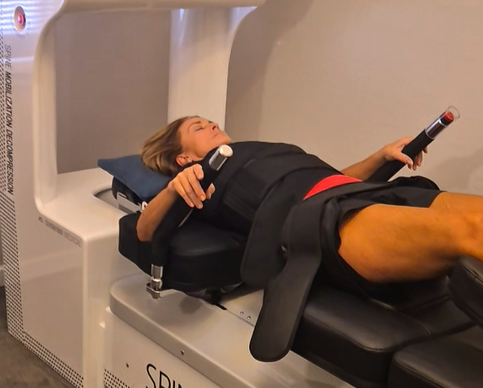
How Does Spinal Decompression Work?
Our Core MT system allows us to control the position, direction and amount of traction applied to the spine.
Treatment is progressive rather than aggressive. Settings are selected according to the area involved, your symptoms, examination findings and how you respond.
A typical session takes approximately 25 minutes.
Some patients feel a gentle pulling or unloading sensation. Others feel very little during the session itself.
The important part is not how much force is used — it is how your symptoms and function respond over time.
Cervical and Lumbar Decompression
Cervical Decompression
Cervical decompression may be considered when symptoms originate from the neck and travel into the shoulder, arm or hand.
These may include:
arm or shoulder ache
burning or nerve-type pain
tingling or numbness
cervical disc bulge or herniation
narrowing around the nerve exits
One useful clinical clue is when arm symptoms ease when the affected arm is raised and rested over the head. This can occur with cervical nerve-root irritation, although it is only one part of the assessment.
In our clinical experience, cervical disc and arm-nerve presentations have been among the most encouraging cases treated with decompression.
Lumbar Decompression
Lumbar decompression may be considered for symptoms including:
lower-back pain
sciatica
buttock or leg pain
tingling or numbness
lumbar disc bulge or herniation
degenerative disc changes
selected cases of longstanding spondylolisthesis
Scan findings do not always predict how somebody will respond.
We sometimes see meaningful symptomatic improvement relatively early despite significant-looking imaging, while longstanding problems often require more time.
Who May Benefit — and Who May Not?
Decompression tends to make most sense when the patient's symptoms, examination findings and imaging fit together.
Not every patient is suitable, and not every disc problem responds.
Some presentations may require further investigation, medical management or surgical assessment instead. These include progressive neurological loss, significant red-flag findings, unstable conditions and some forms of disc sequestration.
We have referred patients for surgical assessment when we believe that is the more appropriate course.
The purpose of your assessment is therefore not simply to decide how we treat you. It is also to decide whether decompression should be used at all.
What Should I Expect?
Most patients tolerate decompression comfortably.
Some notice changes in pain, nerve symptoms or movement quite early. Others respond more gradually.
Longstanding problems generally take longer to change than recent ones, and improvement does not necessarily mean every symptom disappears.
Certain longstanding spondylolisthesis presentations can become mildly more symptomatic during the early stages before settling. Where this occurs, we reassess the response and modify treatment rather than simply pushing ahead.
In selected cases, decompression may also be combined with specific disc or spondylolisthesis-related chiropractic care.
Why a Treatment Plan Matters
We offer a 3-session introductory option for $300 to make it easier for suitable patients to experience decompression before committing to a longer programme.
Three sessions are not intended to represent a complete treatment course.
Disc and nerve problems that have existed for months or years rarely behave like three-treatment problems.
The introductory period helps us determine:
whether you tolerate decompression well
whether your symptoms begin to change
whether the settings need to be modified
whether there is enough positive response to justify continuing
Where the response is encouraging, we can then recommend a more structured programme appropriate to the presentation.
How Do We Know Whether to Continue?
Treatment should not continue indefinitely simply because somebody has started a programme.
We review changes in:
pain
arm or leg symptoms
tingling or numbness
movement
sitting and standing tolerance
sleep
walking and activity
how well improvement holds between visits
If decompression is producing meaningful change, we continue and adjust the plan accordingly.
If it is not, we reconsider the approach.
Response determines direction. How long the problem has existed helps determine how long meaningful recovery may take.
Start With an Initial Disc Assessment
Before recommending spinal decompression, we need to understand what is actually causing your symptoms.
Your 30-minute Initial Disc Assessment with Dr David Kay includes your history, neurological and orthopaedic examination, review of relevant imaging and an assessment of whether decompression is appropriate.
Initial Disc Assessment — $130
Treatment is not included in the initial assessment.
Flexion-Distraction
Gentle movement, real decompression
Flexion-Distraction is a precise, low-force technique performed on a specialised table that gently stretches and releases the spine. This motion reduces pressure inside the intervertebral discs and opens the space where nerves exit the spine — often relieving pain that radiates into the back, legs, or arms.
It’s ideal for people with:
Disc bulges and herniations
Sciatica or nerve compression
Chronic lower back stiffness
Degenerative disc or joint changes
Many patients describe it as a comfortable, controlled movement that helps their back “breathe” again. Over a structured series of visits, Flexion-Distraction can restore mobility, reduce inflammation, and support long-term spinal stability.

Chiropractic & Supportive Techniques
Integrated care for lasting change
Where appropriate, decompression may be combined with specific chiropractic or supportive care.
At Auckland Disc, your program may also include:
Specific Thompson, Diversified, Y-Strap and Gonstead adjustments for precise adjustments
Gentle mobilisation and soft-tissue release
Posture and ergonomic training
Core stability and spinal exercises
On-site digital X-ray imaging to monitor progress
Our integrated approach ensures your treatment doesn’t stop when the pain does — it builds resilience, balance, and confidence in how your body moves.
We are proud of our 23 year history in Remuera. To learn more, visit www.dynamicchiro.co.nz
